
Table of Contents
- Understanding Your Coton de Tulear’s Grooming Needs
- Best Brush for Coton de Tulear: Pin Brushes and Slicker Brushes
- Combs: The Essential Finishing Tool
- How to Groom a Coton de Tulear: Step-by-Step Process
- How Often to Brush a Coton de Tulear
- Nail Clippers and Foot Care Tools
- Building Your Coton de Tulear Grooming Kit
- Common Grooming Mistakes to Avoid
- Frequently Asked Questions
Last Updated: October 18, 2026
Understanding Your Coton de Tulear’s Grooming Needs
A Coton de Tulear‘s thick, fluffy coat requires regular brushing to prevent mats, and knowing the 5 best grooming tools for Coton de Tulear makes the job easier.
Your Coton’s semi-long, cottony coat traps dead hair easily, so mats develop quickly without the right tools and routine. With correct tools and technique, maintenance becomes straightforward.
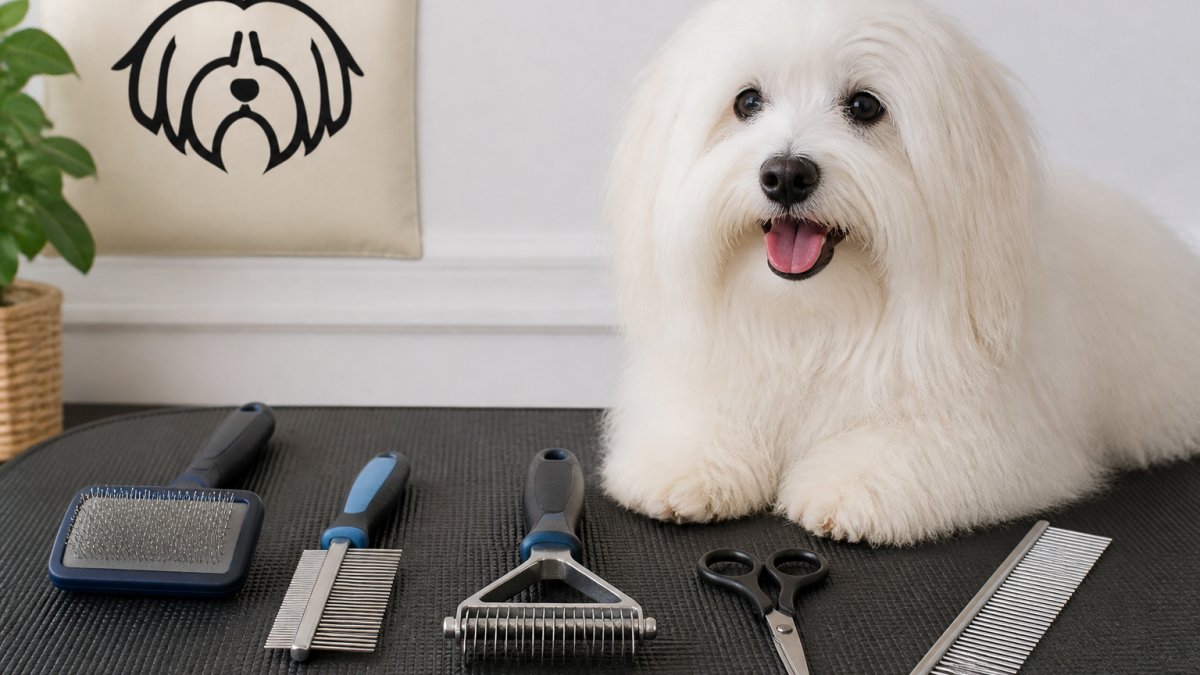
The 5 best grooming tools for Coton de Tulear are:
- Pin brushes for daily maintenance
- Slicker brushes and mat breakers for mat removal
- Combs for finishing work
- Nail clippers for foot care
Quality tools make grooming faster and more effective; poor tools frustrate you and your dog and lead to coat damage.
Best Brush for Coton de Tulear: Pin Brushes and Slicker Brushes
The best brush for Coton de Tulear grooming depends on the task. Pin brushes and slicker brushes serve different purposes, and most owners need both. The difference between a brush that glides and one that scratches comes down to pin design, pad flexibility, and size.
What to look for in a pin brush
A pin brush is your go-to for daily brushing. Uncoated metal pins separate thick fur without damaging it, remove loose hair without pulling, and work on both puppies and adults. Pin brushes work best on a dry or lightly dampened coat.
Buying criteria that actually matter:
- Pin tips: Rounded or polished tips; bare cut-metal ends drag and scratch. Uncoated polished stainless is the safer default over coated tips, or tips with balls at the end which can snag coarse Coton coat.
- Pin length: Roughly 3/4 to 1 inch for a semi-long, coarse coat. Shorter pins skate over the topcoat; longer pins reach the undercoat.
- Pin spacing: Moderate spacing (roughly 1/8 to 3/16 inch) separates coat rather than raking it; dense pin fields load up fast on a Coton.
- Pad flexibility: A slightly flexible air-cushion pad follows contours around shoulder and hip; rigid pads dig in on curves.
Most owners use a pin brush three to four times per week to prevent mats and dead-hair buildup.
What to look for in a slicker brush
A slicker brush has short, fine wires packed closely together, cutting through mats pin brushes cannot reach. Use it after working through the coat with a pin brush to handle remaining mats and remove dead hair more aggressively.
Buying criteria for slickers:
- Wire gauge and flexibility: Fine, flexible wires with rounded tips; stiff, thick wires scratch a Coton’s skin.
- Wire density: Medium density is easier to keep clean during a long session than dense fields that load up quickly. However the dense slicker can pick out those fine little “comet looking” mats left behind by other brushes or mat cutters.
- Pad size: Small for precision around ears, armpits, and hocks; medium for the body only.
Common mistakes with slicker brushes:
- Using them on dry coats (causes discomfort and potential skin irritation)
- Brushing too hard and damaging the coat
- Skipping the pin brush step first
- Using them too frequently on sensitive areas
Slicker brushes work best on slightly damp coats; lightly mist the coat first to reduce pulling and help the brush glide through tangles.
Pin brush vs. slicker brush: which one for which job
|
Coat condition or task |
First tool |
Follow-up tool |
Why |
|---|---|---|---|
|
Daily maintenance, no mats |
Pin brush |
Comb |
Separates coat without scraping skin |
|
Light tangles behind ears |
Pin brush |
Slicker (small) |
Pin loosens, slicker lifts the tangle |
|
Dense undercoat after shedding |
Slicker |
Pin brush |
Slicker pulls dead undercoat, pin smooths |
|
Puppy first grooming sessions |
Soft pin brush |
Comb |
Gentlest introduction to handling |
|
Post-bath, damp coat |
Pin brush |
Slicker |
Damp coat gives slicker glide |
|
Senior dog with thin skin |
Soft pin brush |
Comb only |
Avoid wire contact on sensitive skin |
Budget and value
You do not need a salon-grade brush for one Coton. Expect roughly $15-$35 for a solid pin brush and $15-$30 for a slicker; mid-range buys better pin tips and a pad that does not warp. Replace a brush when pins bend, tips roughen, or the pad loses its cushion, a worn brush snags coat and creates the mats you are trying to prevent.
Combs: The Essential Finishing Tool
After brushing, a comb completes the job by finding mats and tangles brushes miss, and it helps desensitize your dog to grooming.
Poodle Combs and Greyhound Combs
A poodle comb has two tooth spacings: fine teeth for finishing and wider spacing for thicker areas. A greyhound comb has one consistent spacing, simpler, and good for daily finishing. Choose the poodle comb for thick coats with varying mat risk, the greyhound for maintenance and final smoothing. Both should glide without resistance; if you feel resistance, a mat is present and needs pin brush or slicker work first.
How to Groom a Coton de Tulear: Step-by-Step Process
Proper grooming technique prevents coat damage and keeps your dog comfortable. Follow this process every grooming session.

Step-by-step diagram showing how to use a pin brush on a Coton de Tulear’s coat for the 5 best grooming tools for Coton de
Brushing Technique and Removing Dead Hair
Start with a pin brush on a lightly dampened coat (use a fine mist bottle with brushing spray of your choice, brushing in the direction the hair grows. Work systematically from head to tail, one section at a time, with gentle pressure, pressing hard doesn’t remove more dead hair, it just causes discomfort and skin irritation.
Brush in small sections: head and ears, neck and shoulders, back and sides, then legs and tail. Spend extra time behind the ears, under the armpits, and around the rear end, trouble spots that need attention every session.
Safe Dematting for Stubborn Tangles
If you find a mat, never pull hard, pulling causes pain and permanent coat damage.
Dematting steps:
- Identify the mat and assess its size
- Loosen the outer edges with your fingers
- Apply a small amount of detangling spray if needed
- Gently work through loose sections with a pin brush
- Switch to a slicker brush for the remaining mat.
- Use mat breaker if the mat remains intact.
- Work slowly and take breaks if your dog shows discomfort
For severe mats close to the skin, stop and consult a professional groomer. Prevention is easier: brush thoroughly twice weekly to stop mats before they start.
How Often to Brush a Coton de Tulear
Brushing frequency depends on your dog’s age and coat condition. A consistent routine prevents most grooming problems.
WANT TO KNOW MORE ABOUT YANKEE COTONS? →
Puppy, Adult, and Senior Grooming Schedules
Puppies (8 weeks to 1 year): Brush 2-3 times per week with gentle techniques and short sessions to build positive associations. When coat change begins at about 7 -12 months of age, increase to daily.
Adult dogs (1-7 years): Brush 3-4 times per week.
Senior dogs (7+ years): Brush 2-3 times per week with gentler, shorter sessions, watching for skin sensitivity and monitoring for lumps or skin changes.
Nail Clippers and Foot Care Tools
Long nails cause discomfort and affect how your dog walks. Trim every 4-6 weeks; a clicking sound on hard floors is your signal to clip.
Choosing a clipper or grinder
Clippers come in two styles: scissor-style (easier to control) and guillotine-style (faster but needs practice). I prefer scissor-style.
Sizing matters more than style. Small-breed clippers fit a Coton’s nails; oversized clippers crush rather than cut. Replaceable-blade clippers stay sharp longer and cut cleaner than fixed-blade budget models. A rotary grinder smooths sharp edges after clipping but is not a substitute on really long nails, grinders take many passes and can heat the nail if using the sandpaper barrels. There are diamond heads that can be purchased which eliminate the heat issue of grinding but are rather expensive.
Finding the quick safely
On a Coton, the quick is often visible as a pink core through a translucent nail. On darker nails, look at the cut surface: a chalky gray-white center means you are still in the safe zone; a dark dot or pink center means stop. Clip in small slivers, roughly 1/16 inch at a time, and check after each pass. Keep styptic powder on hand before you start, not after a slip.
Foot and paw hair trimming
Trim hair around the feet and between the toes to prevent moisture, debris, and infections. Use blunt-edge scissors, pointing away from the pad and parallel to the skin, and trim only hair clearly sticking out over the pad. For between the toes, a small rounded-tip scissors or narrow clipper with a 10 blade is easier to control than full-size shears.
Foot care toolkit
A practical foot-care kit for a Coton includes:
- One pair of small-breed scissor-style clippers
- Styptic powder
- One pair of blunt- or rounded-tip scissors
- A small slicker or comb for lifting hair away from the pad before trimming
- Optional: a rotary grinder for smoothing edges
Building Your Coton de Tulear Grooming Kit
A complete kit includes the essentials and nothing more:
- One pin brush (small or medium)
- One slicker brush
- One poodle comb or greyhound comb
- One pair of scissor-style dog nail clippers
- One pair of blunt-edge scissors
Store tools in one place so they’re ready for each session. Quality matters more than quantity, one good pin brush outperforms three cheap ones. Replace tools when dull pins or bent teeth make them ineffective; a worn brush creates more work and frustrates both you and your dog.
Common Grooming Mistakes to Avoid
Knowing what NOT to do prevents coat damage and keeps sessions positive.
Grooming only when mats appear: Waiting means emergency dematting; regular brushing prevents 90% of mat issues.
Brushing hair when totally dry: Always mist each area o the coat as you are brushing it.
Neglecting behind the ears and armpits: These areas mat fastest and need extra attention every session.
Yankee Cotons recommends establishing a grooming routine early.
Grooming your Coton de Tulear doesn’t require expensive equipment or professional skills, the right tools and a simple routine keep the coat healthy and mat-free. Visit our Puppies For Sale page to learn more about finding your next companion.
Frequently Asked Questions
What is the best brush for a Coton de Tulear dog?
Pin brushes with uncoated metal pins are ideal for the Coton de Tulear’s thick, coarse coat. They work through the dense fur without damaging it and remove dead hair effectively. Slicker brushes complement pin brushes for removing mats and tangles. Most owners find a small or medium-sized pin brush works best for this breed’s coat texture and size.
How often should I brush a Coton de Tulear?
Adult Cotons need brushing 3-4 times per week to prevent matting and maintain coat health. Puppies benefit from 2-3 brushing sessions weekly to establish routine and prevent tangles. Once coat change begins in a puppy, increase the frequency to daily. Senior dogs may need less frequent brushing but still require 2-3 sessions per week.
How do I safely remove mats from my Coton de Tulear’s coat?
Start at the mat’s edges using a slicker brush or greyhound comb, working gently outward. Use short, light strokes rather than pulling forcefully, which can cause skin irritation. For stubborn mats, try a mat breaker. If a mat is too tight, consider professional grooming to avoid damaging the coat or skin.
What tools should I include in a Coton de Tulear grooming kit?
A complete grooming kit includes a pin brush, slicker brush, mat breaker, poodle comb, greyhound comb, dog nail clippers, blunt-edge scissors for trimming hair around the feet, and a spray bottle for conditioning. Start with essential tools and add specialized items as you develop your grooming skills. Quality tools last longer and work more effectively on the breed’s coat.
Leave a Reply