
Table of Contents
- Why Owner Education on Canine Health and Reproduction Matters
- How to Verify Dog Health Clearances Before You Buy
- Questions to Ask a Dog Breeder About Health
- Dog Pedigree and Lineage Records: What They Reveal
- Responsible Dog Breeder Health Records: What to Expect
- Canine Reproduction Basics: Timing, Screening, and Pregnancy
- Access to Veterinary Care and Low-Cost Services
- Conclusion
- Frequently Asked Questions
Last Updated: October 16, 2026
Why Owner Education on Canine Health and Reproduction Matters
Canine health is the foundation of every good decision a dog owner makes, from choosing a breeder to planning a litter, yet many owners walk into that first purchase with no framework for judging what a healthy dog looks like on paper.
Most buyers ask “is this puppy cute and available?” instead of “can this breeder prove the parents are healthy?” Only the second protects you eighteen months down the line.
Below, we break down how to verify health clearances, read a pedigree, question a breeder, and understand the reproduction basics behind healthy litters.
How to Verify Dog Health Clearances Before You Buy
Verifying dog health clearances means confirming a breeder’s claimed test results exist in an independent public database, not just on paper. Any breeder can print a certificate; few can point you to a searchable record.
The process is straightforward:
- Request the registered name and certificate number for each parent
- Search the relevant health database by registered name and breed
- Confirm the dog’s identity matches the certificate exactly
- Check the clearance date and whether it is still current
- Cross-reference the database result against the breeder’s own records

Reading OFA and PennHIP Certifications
The Orthopedic Foundation for Animals (OFA) maintains a public database where you can look up hip, elbow, eye, and cardiac clearances by registered name.
What most buyers miss is that some clearances have an expiration window. A patella or cardiac clearance from five years ago tells you about a five-year-old dog, not the dog in front of you today. Hip clearances is usually done once, and DNA tests are obviously needed only once in the dog’s lifetime since genetics don’t change in an individual dog.
Questions to Ask a Dog Breeder About Health
The right questions to ask a dog breeder about health are specific, verifiable, and uncomfortable:
- Which specific genetic tests have you run on both parents, and what were the results?
- Can I see the OFA or PennHIP certificates?
- What health issues have appeared in this bloodline, and how did you address them?
A breeder who answers all five without hesitation is worth trusting. One who deflects on two or more is telling you something.
Dog Pedigree and Lineage Records: What They Reveal
Dog pedigree and lineage records reveal far more than a list of names. A pedigree is a map of inherited traits, and reading it correctly lets you spot risks a breeder might not mention.
A pedigree shows the ancestors behind your puppy, usually three to five generations back. What matters is not how many champions appear, but how often the same dogs appear more than once, and whether those repeated ancestors produced conditions you are trying to avoid.
How to Read a Pedigree Like a Health Document
A standard pedigree is a grid: the sire’s side runs down one half, the dam’s side down the other, and each generation moves one column right. Work through it like this:
- Start with the parents and confirm their registered names match the health clearances you already verified.
- Move one generation back and write down every ancestor’s registered name.
- Highlight any name that appears more than once anywhere in the grid.
- For each repeated name, note how many generations back it sits and on which side of the family.
- Cross-reference the repeated names against the OFA database and any breed-specific health registries.
- A pedigree that repeats the same dog three or four generations back on both sides signals a narrow gene pool. That is not automatically disqualifying, but it raises the stakes on genetic testing.
Interpreting Inbreeding Coefficients and Ancestor Loss
An inbreeding coefficient is a percentage expressing how closely related a dog’s parents are to each other, and therefore how much genetic material the puppy shares from common ancestors.
Ancestor loss measures how many unique ancestors appear in a pedigree versus how many could.
If a breeder cannot tell you the inbreeding coefficient for a planned pairing, press on it. Free tools exist for calculating it from a pedigree, and any breeder doing serious planning will know the number.
Tracing Inherited Conditions Through a Bloodline
Lineage records are only useful if you connect them to health outcomes. Build a simple family health history for the puppy:
- If the breeder owned several generations of dogs in the pedigree, ask for the health status of the parents, grandparents, and great-grandparents where known. If they were dogs bred and raised by other breeders, it is possible little to no information will be available.
- Ask specifically about the conditions most common in the breed, for Coton de Tulear, that includes hip dysplasia, patellar luxation, intervertebral disc disease, and cardiac issues.
- Note the age at which any condition appeared. Early onset in a close ancestor is a stronger signal than late onset in a distant one.
A breeder who keeps this history and shares it openly is doing the work. One who only has names and titles is not.
Where to Get and Store Lineage Records
Owners often lose track of pedigree and health records within the first year. Keep a single folder, physical or digital, with the pedigree, every health clearance certificate number, genetic panel results, and vaccination history. Having them in one place saves hours when you share records with a veterinarian, a future breeder, or a registry. The OFA database is searchable by registered name, so you can always re-verify a clearance even if the paper copy is gone.
Responsible Dog Breeder Health Records: What to Expect
Responsible dog breeder health records should be complete, current, and independently verifiable. Incomplete records or verbal-only claims are a red flag regardless of how good the dogs look. A complete record set includes:
|
Record Type |
What It Proves |
How to Verify |
|---|---|---|
|
OFA hip/elbow clearance |
Joint structure is sound |
Search OFA database by registered name |
|
PennHIP distraction index |
Numerical hip laxity score |
PennHIP report from the breeder |
|
Genetic panel results |
Carrier status for breed conditions |
Lab report with dog’s name |
|
Eye certification |
Current ocular health |
OFA or veterinary ophthalmologist record |
|
Cardiac clearance |
Heart function at time of exam |
OFA database entry with date |
|
Vaccination and deworming history |
Puppy health timeline |
Veterinary or breeder record with dates |
Canine Reproduction Basics: Timing, Screening, and Pregnancy
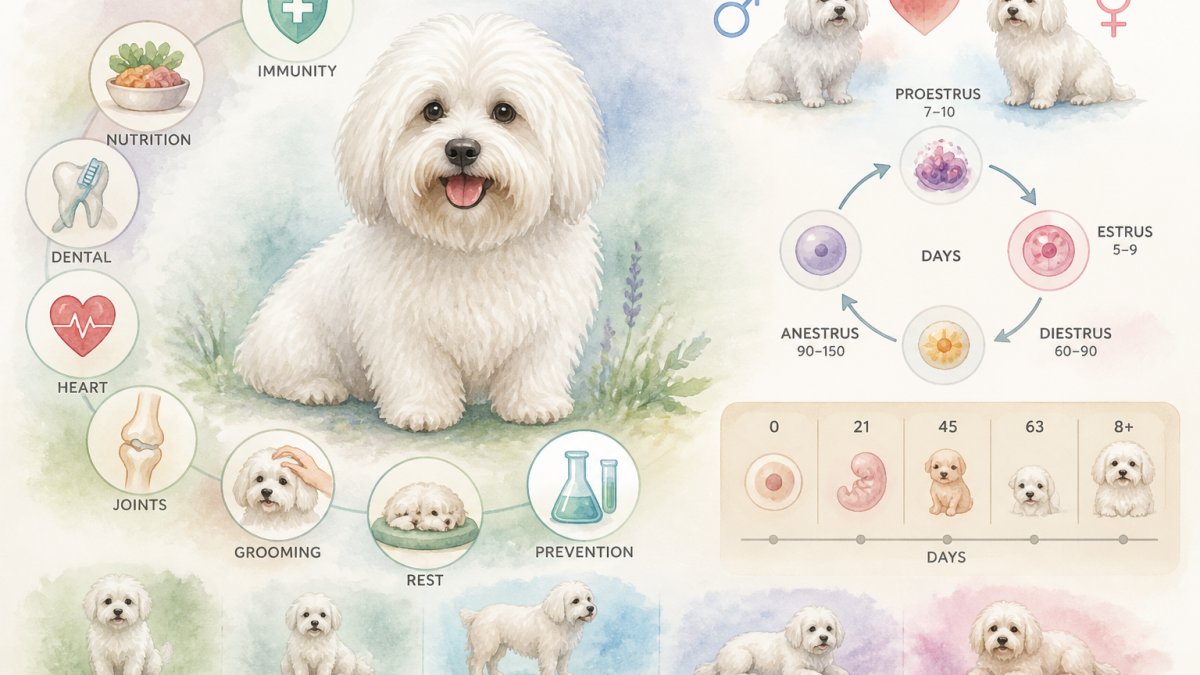
Canine reproduction is the process of planning, timing, and managing a breeding pair through conception, pregnancy, and birth. Getting it right requires more than putting two dogs together, and the decisions at each stage depend on the ones before it.
Stage 1: Planning and Pre-Breeding Screening
Screening comes before timing. Both dogs should be assessed for genetic conditions, structural soundness, and overall health before any breeding takes place.
A pre-breeding health assessment combines a physical exam, breed-specific genetic testing, and a review of both dogs’ lineage records.
WANT TO KNOW MORE ABOUT YANKEE COTONS? →
Carrier dogs can still be bred responsibly if paired with a clear dog. Affected dogs should not be bred at all.
Stage 2: Timing the Breeding Window
A dam is only fertile during a narrow window in her cycle, and breeders can track this through progesterone testing rather than guesswork, especially if they have no intact breeding males in the same household to let the breeder know when the bitch is receptive to breeding. Progesterone testing can be done in the vet’s office or many breeder’s now have their own machine to test their bitches if they are willing to draw the blood needed.
Breeding too early or too late simply does not produce a litter. Fresh semen can typically fertilize eggs for several days after breeding, but the eggs themselves remain viable for a much shorter window. That is why progesterone timing beats calendar counting every time.
Stage 3: Confirming Pregnancy
Pregnancy confirmation usually follows within a few weeks. Ultrasound can typically detect pregnancy about three to four weeks after ovulation, and a relaxin blood test can be run around the same window. Radiographs later in pregnancy give the a puppy count as well, but many a discussion of exactly how many puppies are seen have occurred. All of this can assist in planning a safe whelping.
Stage 4: Monitoring Through Whelping
Pregnancy runs 63 days from ovulation, not from the date of breeding.
A problem pregnancy needs veterinary involvement quickly, which is one reason access to care matters so much. Signs that warrant an immediate call include prolonged straining without producing a puppy, a dam that stops contractions, or a temperature drop followed by no labor within the expected window.
Stage 5: Neonatal Care and Placement
Puppies are born unable to regulate their own temperature, urinate, or defecate without stimulation, making the first two weeks the highest-risk period of the entire process.
Placement comes next. Responsible breeders will tell each of the prospective buyers the current temperament of the puppies, but realize and inform the buyers that it is simply a snapshot of the puppy at that moment in time. Temperament testing at this young age has not been found to be reliable enough to base long term decisions. They send each puppy home with the health records, vaccination history, AKC or UKC registration application and lineage documentation the new owner will need for the rest of the dog’s life.
Access to Veterinary Care and Low-Cost Services
Access to veterinary care is not evenly distributed, and cost is the most common barrier owners face.
Low-cost veterinary services exist in most communities through shelters, humane societies, and veterinary teaching hospitals, offering wellness exams, vaccinations, and spay/neuter at reduced rates.
For breeding-specific care, you will generally need a full-service veterinarian. Reproductive management, progesterone testing, and pregnancy monitoring fall outside what most low-cost clinics provide.
The AVMA resources on finding veterinary care can help you locate providers, and OFA’s public health database lets you verify clearances independently before you commit to anything.
One more thing worth saying plainly: sometimes the most responsible decision is not to breed at all.
Conclusion
Choosing a dog, or planning a litter, is a decision that echoes for years. The owners who get it right learned to read the records before they fell in love with a face.
At Yankee Cotons, we built our entire approach around that idea: over 30 years of experience, a commitment to medical screening and health clearances, and a dedication to owner education that starts long before you bring a puppy home.
Get started with Yankee Cotons and bring home a Coton de Tulear raised with transparency, health, and lifelong support behind it.
Frequently Asked Questions
What health tests should responsible dog breeders complete?
Responsible dog breeders complete health screenings recommended by the breed’s parent club and the Orthopedic Foundation for Animals (OFA). For most breeds, this includes hip and elbow evaluations, eye examinations through the Companion Animal Eye Registry (CAER), and cardiac screenings. Genetic testing for breed-specific conditions such as von Willebrand disease, degenerative myelopathy, or intervertebral disc disease is also standard. Breeders should test both sire and dam before breeding and provide copies of all results to puppy buyers.
How can I verify a dog’s health clearances?
Ask the breeder for the dog’s registered name and clearance certificate numbers. Then search the OFA database online, which is free and public. Enter the dog’s registered name to confirm hip, elbow, eye, and cardiac clearances. Cross-reference the database results with the paperwork the breeder provides. If a breeder cannot supply certificate numbers or the database shows no record, treat that as a red flag and ask for an explanation before proceeding.
What should I look for in a dog’s pedigree and lineage records?
A pedigree should show at least three to four generations of ancestry with registered names and numbers. Look for titles, health clearances, and any repeated ancestors. A responsible dog breeder will explain the lineage, including any known carriers of genetic conditions. Ask about the coefficient of inbreeding (COI) if available. High COI values indicate closely related parents and raise the risk of inherited health problems. The pedigree is a tool for understanding genetic diversity, not just a list of names.
What health records should a breeder provide to a puppy buyer?
A responsible dog breeder provides vaccination records, deworming schedules, veterinary exam notes, and copies of both parents’ health clearances. Genetic test results for the parents. The breeder should also supply a written contract outlining health guarantees and return policies. Request the puppy’s microchip number if appicable and registration application papers. If the breeder hesitates to share these documents, that is a sign to ask more questions or walk away.
What should dog owners know about canine reproduction?
Canine reproduction involves more than mating. Responsible breeding includes pre-breeding health screening, timing based on progesterone testing, pregnancy confirmation via ultrasound or X-ray, and monitoring for problem pregnancies. Owners should understand that breeding carries risks for the dam, including eclampsia and dystocia. Neonatal care for puppies requires warmth, feeding support, and early veterinary checks. Ethical breeders plan each litter carefully and are prepared to keep or rehome any puppy that cannot be placed.
Where can I find reliable information about dog breed health?
Start with the Orthopedic Foundation for Animals (OFA) for screening statistics and the Canine Health Information Center (CHIC) for breed-specific testing requirements. The American Kennel Club provides breed standards and health resources. University veterinary schools and the National Institutes of Health offer research-based articles. Breed-specific rescue organizations often publish health guides. Avoid forums and social media groups as primary sources; use them only to find questions worth asking your veterinarian or breeder.
Leave a Reply